


David N. Hosking

Lecturer in Theoretical Plasma Physics
University of Edinburgh

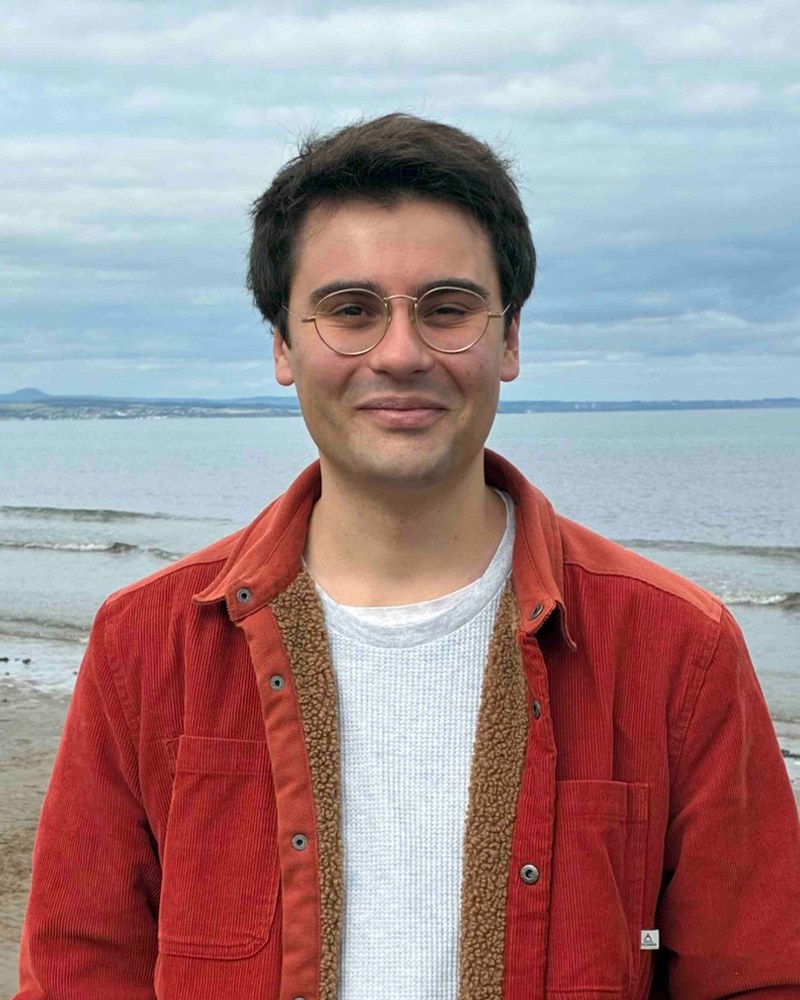
Portrait of David Hosking

I am a theoretical physicist interested in how complex, nonlinear systems with many degrees of freedom conspire to organise their dynamics. I primarily pursue this interest in the context of plasmas: gases of charged particles interacting through electric and magnetic fields. Their remarkably rich dynamics underpin the behaviour of myriad astrophysical systems and of terrestrial devices that target clean-energy production through nuclear fusion. My research addresses problems in both settings, spanning instabilities, waves, turbulence, magnetic reconnection, and the dynamo effect.

I am offering PhD projects starting in 2027. Please do get in touch if you would like to work with me.

I studied Mathematical and Theoretical Physics at Merton College, Oxford (MMathPhys, 2018) and stayed on in Oxford for a DPhil in Astrophysics (2022), supervised by Alex Schekochihin and Steven Balbus. My thesis was about how plasma turbulence decays, with consequences for magnetic fields in the early Universe. From 2022 to 2025 I was a Postdoctoral Fellow at the Princeton Center for Theoretical Science; from 2025 to 2026 I was a Research Fellow of Gonville & Caius College, University of Cambridge; and since September 2026 I have been Lecturer (assistant professor) in Theoretical Plasma Physics at the University of Edinburgh.

What follows gives a flavour of two strands of my research.

Decaying turbulence in magnetised plasmas

Imagine stirring up a fluid with very low viscosity and then allowing the turbulent motions to decay away. How would the energy of the flow depend on time? The answer is that energy decays at the “turnover” (roughly, rotation) rate of the largest eddies. As the flow becomes increasingly weak, that rate is constrained by dynamical invariants related to the random momentum carried by large patches of fluid. This enables the energy to be calculated as a function of time.

What about magnetic fields in a plasma? In this case, magnetic structures relax towards local quasi-equilibrium states with random, non-zero magnetic helicity—a measure of the twist and linkage of magnetic field lines. Even when the total magnetic helicity vanishes, large regions contain random excesses of positive or negative helicity, and a statistical measure of these fluctuations remains approximately conserved as the field relaxes. In cases where the energy of the magnetic field dominates over that of plasma flows, magnetic reconnection—the breaking and rejoining of field lines that lets neighbouring structures merge—controls the decay timescale, while helicity conservation constrains how field strength and structure size evolve together (Phys. Rev. X, 2021).
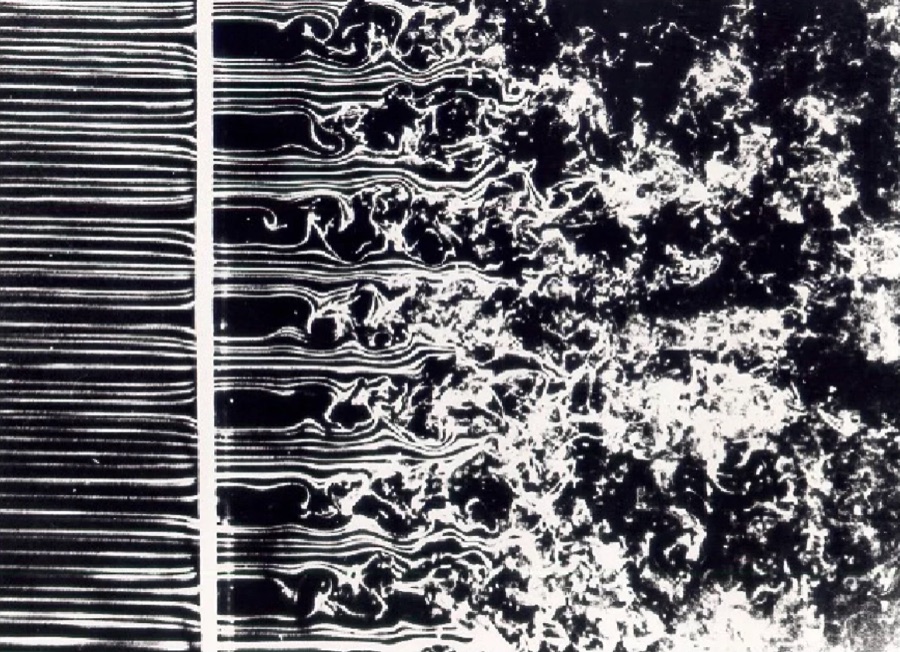
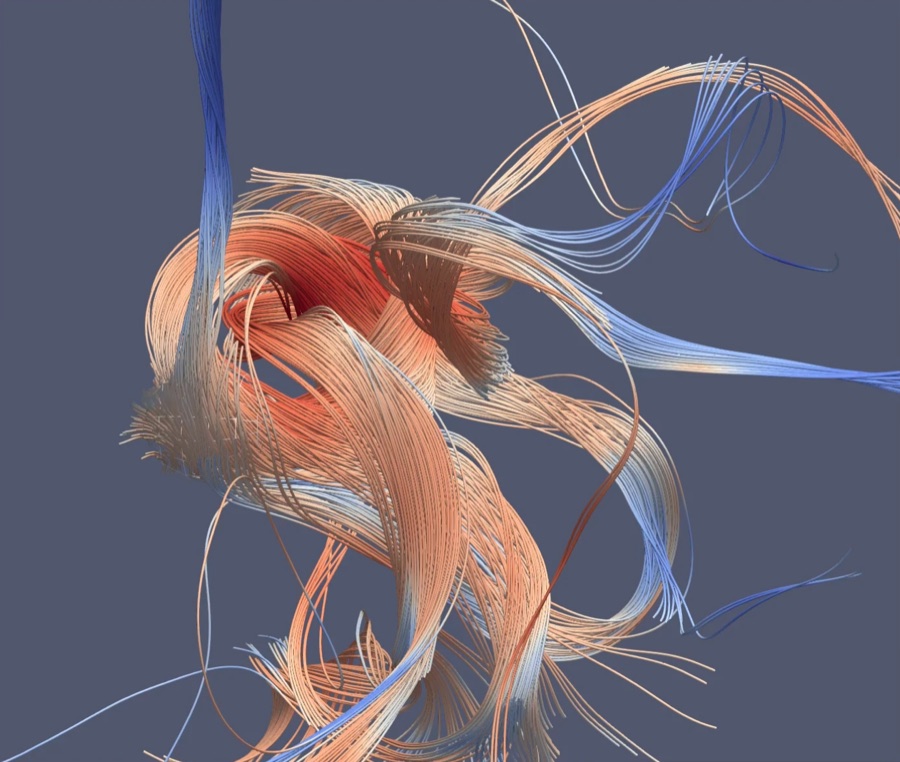
Smoke streaklines passing through a grid, breaking up into decaying turbulence downstream Tangled bundles of magnetic field lines, coloured red and blue, from a simulation of decaying MHD turbulence
The photograph shows an experiment in which a fluid flows through a grid, from left to right (from M. Van Dyke, An Album of Fluid Motion, 1982). Smooth streaklines break up into eddies that decay downstream; the ideas above describe that process. The second image shows tangled bundles of magnetic field lines in a simulation of decaying magnetohydrodynamic (MHD) turbulence.

These ideas explain several puzzling features of relaxing chaotic magnetic fields, chief among them their tendency to transfer energy to larger scales, even when their total helicity vanishes. They also have consequences for cosmology: they imply that magnetic fields generated at the electroweak phase transition, a fraction of a nanosecond after the Big Bang, could survive to the present with strengths several orders of magnitude greater than earlier estimates, consistent with magnetic-field constraints inferred from gamma-ray observations of blazars (Nature Commun., 2023).
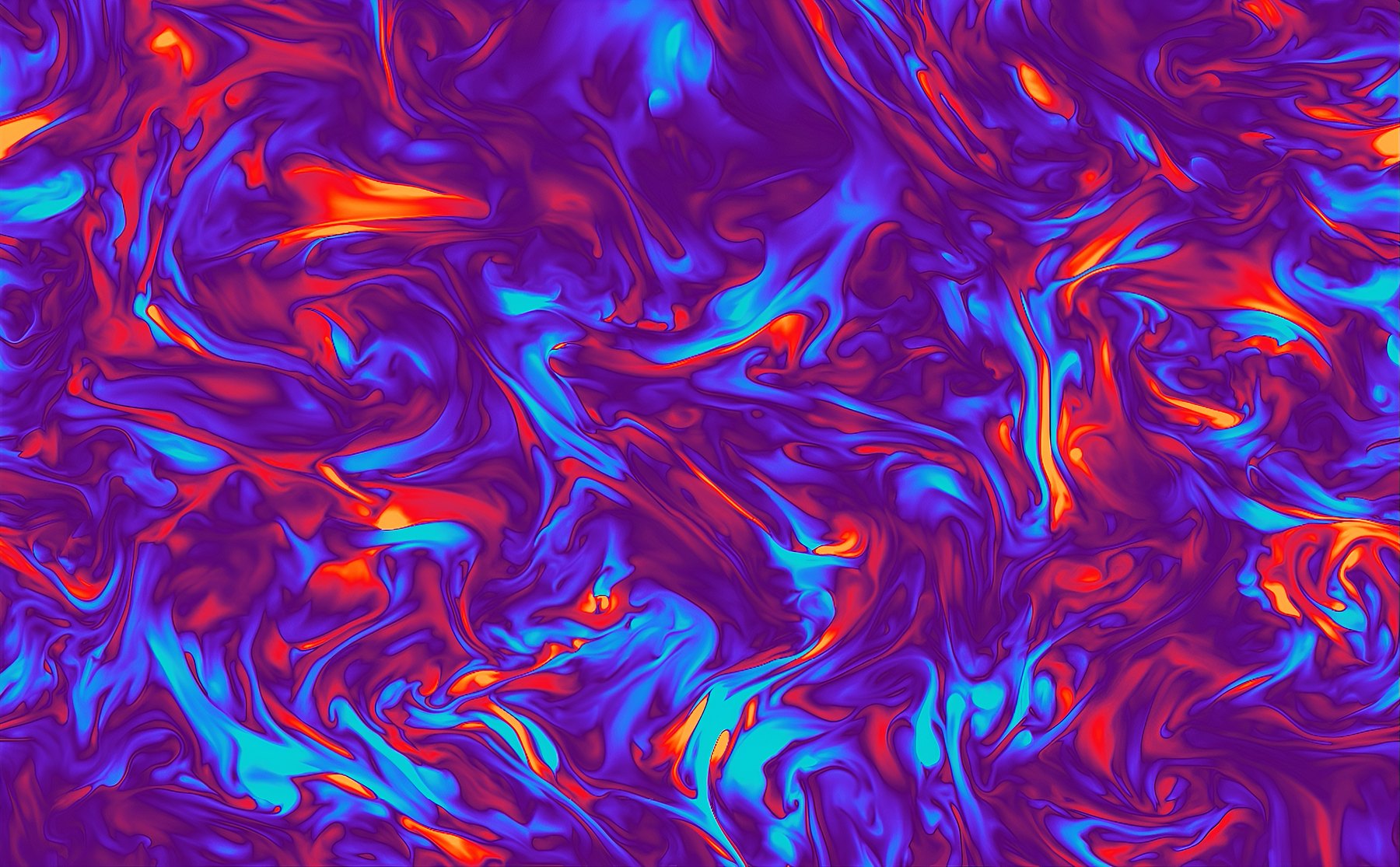
Turbulent field of magnetic-helicity density, with red and blue regions of opposite sign twisted together
Magnetic-helicity density in a simulation of decaying MHD turbulence, started from the saturated state of a turbulent dynamo; red and blue indicate opposite signs of magnetic-helicity density. Random excesses of one sign over large regions, and the need to conserve them statistically, constrain how the field can decay. Simulation by Zach Hemler.

Explosive instabilities in fusion plasmas

Magnetically confined plasmas in fusion experiments can sometimes lose their equilibria in dramatic fashion. In tokamaks operating in high-confinement mode, type-I edge-localised modes (ELMs) expel hot plasma from the edge, causing potentially catastrophic heat loads on surrounding components. One explanation for these abrupt eruptions is that the plasma edge is metastable beforehand: stable to small perturbations, but unstable to sufficiently large ones. I have been looking for simplified plasma regimes in which such states and their relaxation can be studied tractably.

Two-dimensional interchanges of flux tubes, in which tubes of magnetic flux swap places much as buoyant fluid rises in convection, turn out to be one. There, we can calculate the available energy of a metastable equilibrium (the energy it could release by rearranging its flux tubes) by combinatorial optimisation, and develop statistical predictions for the state to which it relaxes (J. Plasma Phys., 2025).

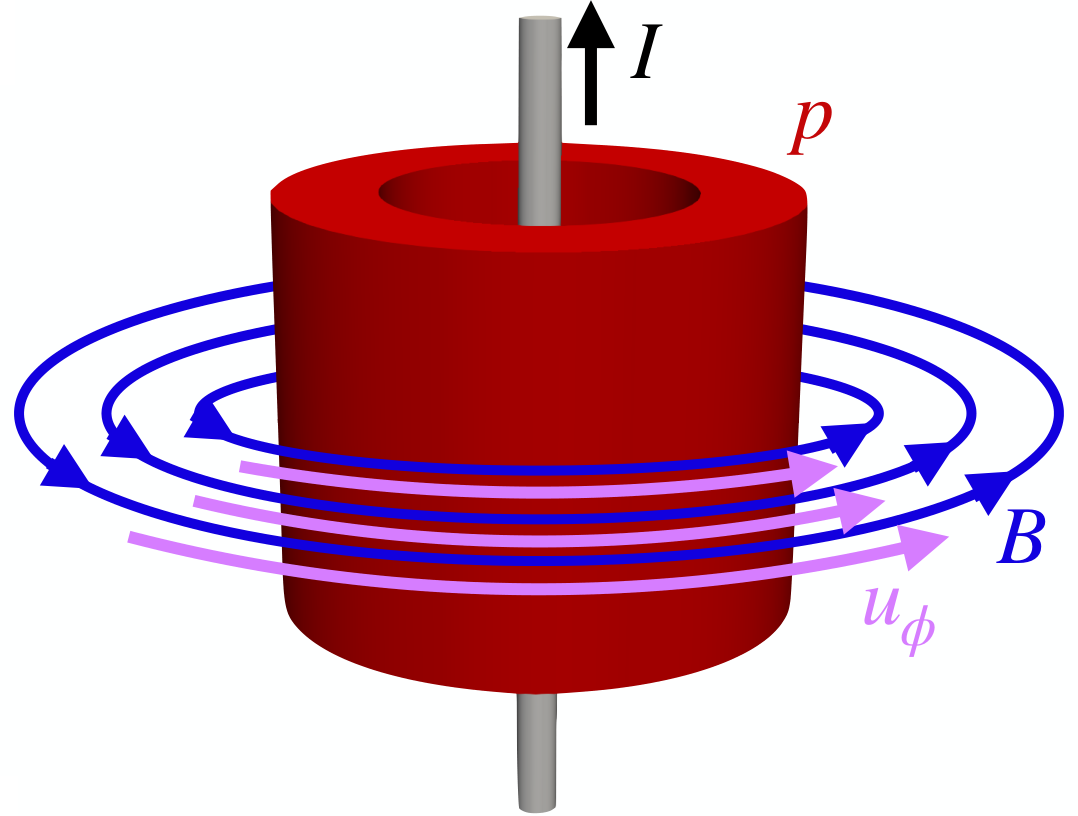
A rotating Z-pinch, a column of plasma confined by the magnetic field of a current flowing along it, provides a second example. In that case, a sheared flow can sustain a transport barrier: a layer in which a steep pressure gradient is held stable. Under slow heating, the barrier steepens until a stable flux-tube equilibrium disappears in a saddle-node bifurcation, triggering an eruption. The transport barrier then rebuilds, and the cycle repeats (arXiv, 2026).

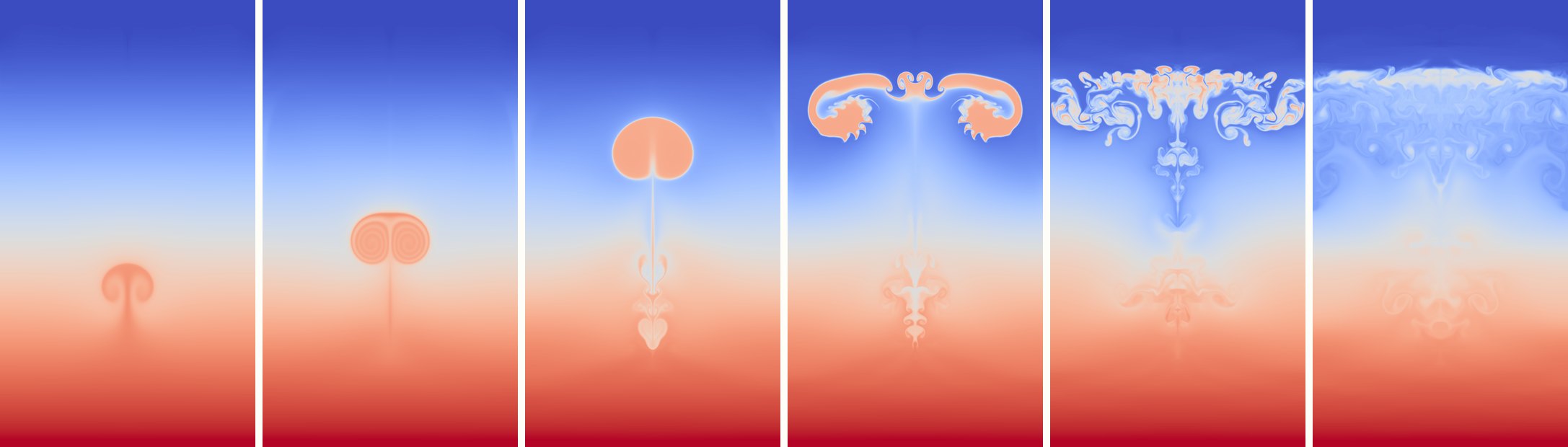
Six frames from a simulation in which a small rising plume grows, erupts, and mixes a stratified plasma
A metastable equilibrium, kicked by a localised force, erupts. Frames from a two-dimensional simulation of interchange dynamics under gravity, later times to the right. Colour shows entropy per unit flux, which controls how compressible the plasma is: red indicates more compressible material. From J. Plasma Phys. 91, E35 (2025).
Schematic of a hard-core Z-pinch: an annulus of plasma around a current-carrying rod, encircled by magnetic field lines with flows along them
Schematic: a rotating Z-pinch. Plasma of pressure p is confined by the azimuthal magnetic field B of an axial current I, and flows along the field with velocity uφ. Movie: interchange turbulence in a Z-pinch with a transport barrier. Under slow heating the barrier collapses and rebuilds in a cycle: a simplified model that reproduces key features of the ELM cycle. From arXiv:2602.06012.

I am offering PhD projects in theoretical plasma physics starting in 2027. Project descriptions, funding and application details are coming soon. In the meantime, please get in touch by email.

Please write your enquiry in your own words, rather than using AI to compose it. I would be delighted to receive a short, informal email explaining your interests and what attracts you to my research. Polished prose is not necessary.

Also on Google Scholar, arXiv, ADS, and ORCID.

Preprints

  1. 2026
    D. N. Hosking, L. Swinnerton & R. Kesavan Explosive eruption cycles in a rotating Z-pinch arXiv:2602.06012 arXiv

Journal articles

  1. 2026
    P. Reichherzer, G. Gregori, D. N. Hosking & S. Sarkar Generative diffusion surrogates with analytical variance schedule Nature Commun. 17, 10408 DOIarXiv
  2. 2026
    J. K. J. Hew, D. N. Hosking, C. Federrath, J. R. Beattie & N. Kriel Conservation of magnetic-helicity fluctuations due to spatial decorrelation of fluxes in decaying MHD turbulence J. Plasma Phys. 92, E38 DOIarXiv
  3. 2025
    D. N. Hosking, I. G. Abel & S. C. Cowley Forced 3D reconnection in an exponentially separating magnetic field Phys. Rev. Lett. 135, 255101 DOIarXiv
  4. 2025
    D. N. Hosking, D. Wasserman & S. C. Cowley Metastability of stratified magnetohydrostatic equilibria and their relaxation J. Plasma Phys. 91, E35 DOIarXiv
  5. 2023
    D. N. Hosking & A. A. Schekochihin Cosmic-void observations reconciled with primordial magnetogenesis Nature Commun. 14, 7523 DOIarXiv
  6. 2023
    D. N. Hosking & A. A. Schekochihin Emergence of long-range correlations and thermal spectra in forced turbulence J. Fluid Mech. 973, A13 DOIarXiv
  7. 2021
    D. N. Hosking & A. A. Schekochihin Reconnection-controlled decay of magnetohydrodynamic turbulence and the role of invariants Phys. Rev. X 11, 041005 DOIarXiv
  8. 2020
    D. N. Hosking & L. Sironi A first-principle model for polarization swings during reconnection-powered flares Astrophys. J. Lett. 900, L23 DOIarXiv
  9. 2020
    D. N. Hosking, A. A. Schekochihin & S. A. Balbus Elasticity of tangled magnetic fields J. Plasma Phys. 86, 905860511 DOIarXiv

Thesis

I advise group projects as part of the course Theoretical Methods for Fusion and Astrophysical Plasmas (kinetic theory). I also conduct viva-style assessments for the Numerical Recipes course. For more details on my past teaching endeavours, see my CV.

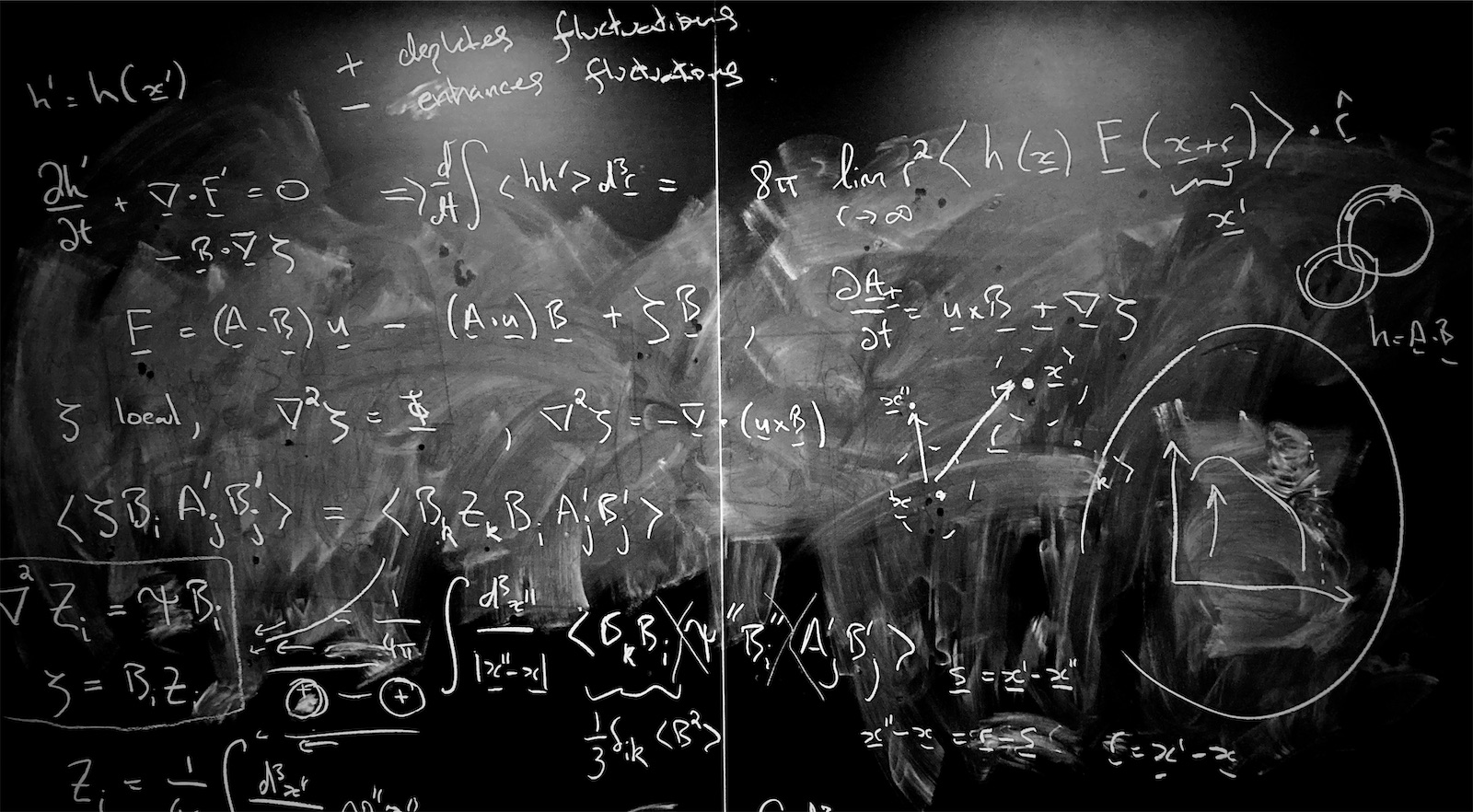
A blackboard covered in chalk calculations of magnetic-helicity fluctuations, with a sketch of linked field lines and a diagram inside a large circle